

 French
 Arabic
 Chinese (Simplified)
 Dutch
Dutch English
 German
 Greek
Greek Italian
 Korean
 Portuguese
 Russian
 Spanish
 Turkish

Abandoned Containers in Tunisia create complex legal and practical issues for maritime carriers, cargo interests and port operators. Dr. Brahim Latrech explains the legal procedure for recovering the equipment while protecting the cargo and complying with Customs and port requirements.
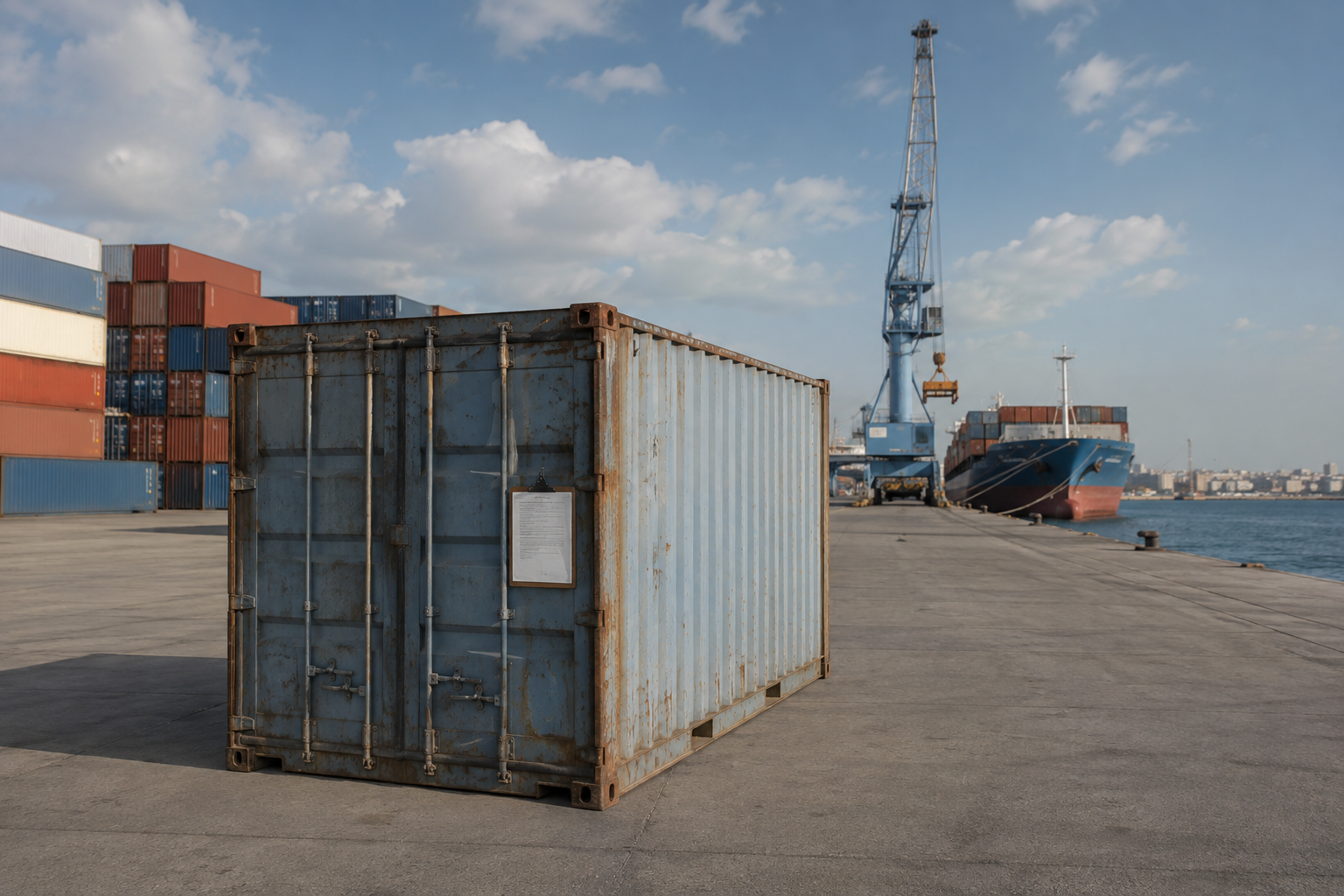
Containers abandoned by cargo interests in Tunisian ports give rise to complex legal and practical issues. A container is not merely packaging for goods; it is a valuable item of transport equipment owned by the maritime carrier or leased from a specialised container company. Its rapid recovery is essential so that it may be returned to commercial circulation.
When the consignee fails or refuses to take delivery of the goods, however, the carrier is faced with a container immobilised inside the port, mounting storage and handling charges, and cargo which the carrier neither owns nor may dispose of unilaterally.
Tunisian law does not provide a single, comprehensive legal regime specifically governing “abandoned containers.” The matter must therefore be addressed through the combined application of the Tunisian Code of Maritime Commerce, Commercial Code, Customs Code, Code of Commercial Seaports, general contract law and the rules governing urgent judicial proceedings.
The central issue is determining the legal procedure by which a carrier may recover its container while preserving the rights of the cargo interests and respecting the powers of the Customs Administration and port authority.
Abandoned Containers in Tunisia: Container and Cargo Are Distinct
A legal distinction must first be drawn between the container and the goods placed inside it.
The container is transport equipment that normally remains the property of the maritime carrier or container lessor. Ownership of the cargo, by contrast, belongs to the shipper, buyer, lawful holder of the bill of lading or final consignee, depending on the contractual relationship and the relevant documents.
Placing goods inside a container does not result in their legal merger, nor does it transfer ownership of one to the owner of the other. The consignee’s abandonment of the cargo does not therefore imply abandonment of the carrier’s container. Likewise, the carrier’s ownership of the container does not entitle it to acquire ownership of, sell or otherwise dispose of the goods placed inside it.
Article 166 of the Tunisian Code of Maritime Commerce defines the consignee as the person legally entitled to take delivery of the goods. It distinguishes between the apparent or named consignee and the actual or final consignee. This distinction is particularly important when identifying the person required to take delivery of the cargo and return the container.
Tunisian maritime case law has consistently treated the bill of lading as a central instrument for identifying the parties, their capacities and their obligations. In Judgment No. 57313 of 3 May 2018, the Tunisian Court of Cassation emphasised the evidential significance of the particulars contained in the bill of lading in relation to both the carrier and the consignee.
In Judgment No. 69168 of 19 February 2025, the Court of Cassation, when considering the application of the Hamburg Rules, distinguished between damage to the cargo and damage to a container that did not belong to the shipper. This distinction confirms that the container may constitute property separate from the cargo and from the shipper’s liability in respect of that cargo, depending on its ownership and the contractual terms.
II. Who Is Required to Return the Container?
For abandoned containers, it cannot be presumed that every person named in the bill of lading automatically becomes liable for container charges. That person’s legal capacity and acceptance of the contract of carriage and its terms must first be established.
Article 630 of the Tunisian Commercial Code provides that where the consignee is not the shipper, the consignee is bound by the obligations arising from the contract of carriage only upon expressly or implicitly accepting them.
Consequently, the mere appearance of a company’s name in the consignee box may not, in itself, be sufficient to hold that company liable for container detention charges, particularly where it establishes that it:
- did not order the goods;
- did not receive the bill of lading;
- did not request delivery of the shipment;
- did not obtain a delivery order;
- and did not undertake any customs formalities demonstrating acceptance of the contract.
Implicit acceptance may, however, be inferred where the consignee requests delivery, presents the bill of lading, initiates customs-clearance formalities, pays part of the freight, requests an extension of the free period or undertakes to return the container.
Article 632 of the Commercial Code provides that freight and expenses attaching to the transported goods are payable by the shipper. Where freight is payable at destination, the shipper and the consignee who accepted the goods are jointly liable for payment.
Accordingly, proceedings for the physical recovery of a container and proceedings for container charges may not necessarily be brought against the same party. The shipper may remain contractually liable for the charges, while the cargo is physically under the control of the consignee.
III. Legal Characterisation of Container Charges
Claims involving abandoned containers require a distinction between three categories of charges that are frequently confused in practice:
- charges arising from a container remaining inside the port terminal after expiry of the free period;
- charges arising from detention of a container outside the port and failure to return it to the carrier;
- port storage and handling charges payable to the terminal operator or stevedoring company.
Depending on the terms of the bill of lading, container charges may constitute agreed compensation for immobilisation of the carrier’s equipment, additional rental charges or a penalty clause for late return.
A carrier cannot prove its claim merely by producing a unilateral invoice. It must establish:
- ownership of, or a lawful right to use, the container;
- that the transport terms were communicated to, or accessible by, the contracting party;
- the applicable free period;
- the daily tariff;
- the date from which the charges began to accrue;
- the identity of the person responsible for the failure to return the container;
- and that the delay was not caused by the carrier itself.
Where the charges amount to a penalty clause, their amount remains subject to judicial review under the general rules of Tunisian law, particularly where the sum claimed is manifestly disproportionate to the container’s value or the loss actually sustained.
A carrier should not be permitted to allow charges to accumulate for years, despite being able to take reasonable steps to release the container, and subsequently claim the entire amount. Its duty to mitigate the continuing loss requires it to act within a reasonable period.
IV. Consequences of the Cargo Remaining Undelivered
The cargo inside abandoned containers remains legally distinct from the equipment. Article 638 of the Tunisian Commercial Code governs goods that remain undelivered. It requires the carrier to notify the shipper, request instructions and await those instructions. The carrier may nevertheless place the goods in safe storage.
The same provision permits the goods to be sold where they are perishable and their nature does not allow sufficient time to obtain the shipper’s instructions.
This provision is important because it provides a general legal basis for separating the cargo from the means of transport and placing it in safe storage. However, where the goods are situated within a commercial port, its application remains subject to Customs legislation and the Code of Commercial Seaports.
The carrier cannot rely solely on Article 638 to open the container or move goods that remain under Customs control without the required authorisation.
V. The Port Authority’s Power to Remove Abandoned Goods
For abandoned containers remaining in a commercial port, Article 106 of the Code of Commercial Seaports, enacted by Law No. 99-25 of 18 March 1999, is one of the principal provisions applicable to abandoned cargo.
It provides that goods may not remain in commercial seaports beyond the period prescribed by the specific regulations governing each port.
For reasons relating to port operations, the safety and security of ships and port facilities, public health, cleanliness or environmental protection, the port authority or port operator may serve written notice upon cargo interests or their representatives requiring the removal of the goods within a specified period.
If they fail to comply, the port authority may order the transfer of the goods.
The carrier does not therefore have the power to decide unilaterally that the cargo should be removed from the container or transferred elsewhere. It may, however, request that the port authority exercise its powers under Article 106, particularly where the container’s continued immobilisation disrupts the normal operation of the port.
Any opening, inventory, transfer or storage operation must be undertaken under the supervision of the port authority and Customs Administration and at the expense of the party legally responsible for the cargo.
VI. Customs Status of Uncollected Goods
The Customs treatment of cargo inside abandoned containers is governed by Articles 265 et seq. of the Tunisian Customs Code, concerning goods placed in Customs deposit.
Article 265 identifies the circumstances in which goods must be placed in Customs deposit. These include goods that have not been assigned a Customs-approved treatment or use within the statutory period and goods that have not been collected following completion of the relevant formalities.
Article 266 requires goods placed in Customs deposit to be entered in a special register.
Under Article 267, goods in Customs deposit remain at their owners’ risk. Their deterioration, alteration or loss during their stay in the deposit does not give rise to a claim for damages against the Customs Administration, subject to the limits prescribed by law.
Article 268 prohibits Customs officers from opening packages in Customs deposit and examining their contents except in the presence of the owner or consignee. Where neither is available, the operation must take place in the presence of a person appointed by the territorially competent court at the request of the Customs Administration.
This rule applies directly to abandoned containers. The carrier may own the external container, but that ownership does not entitle it to open the container unilaterally. Opening and inventory must be conducted in the presence of the cargo interest or a person appointed by the court and under Customs supervision.
VII. Sale of Abandoned Cargo Does Not Include the Container
Where abandoned containers hold uncollected cargo, Article 269 of the Customs Code provides that goods not collected within four months of their entry in the Customs deposit register are to be sold by public auction.
Perishable goods or goods in a poor state of preservation may be sold immediately after authorisation by the President of the territorially competent Court of First Instance, upon application by the Customs Collector.
Goods valued at less than TND 1,000 that remain uncollected after expiry of the prescribed period are deemed abandoned to the State. Customs may sell them by public auction or donate them in accordance with the statutory conditions.
Article 270 provides that the sale is conducted by the Customs Administration to the highest and final bidder. The goods are sold free of Customs duties and taxes, and the successful bidder may assign them to any lawful destination.
Article 271 determines the order in which the proceeds are distributed. Priority is given to expenses incurred by Customs in placing, preserving and selling the goods, followed by Customs duties and taxes, and then any other expenses attaching to the goods.
These provisions concern the cargo and should not extend to the container where the carrier proves its ownership and establishes that the container is not part of the goods.
Before any Customs sale, the carrier should therefore submit evidence of its title to the container, formally request that it be excluded from the sale and seek its release after the cargo has been discharged.
Judicial Recovery of Abandoned Containers in Tunisia
Where the shipper and consignee fail to respond, the carrier may initiate urgent judicial proceedings without waiting for completion of the Customs-sale procedure, provided it establishes continuing harm arising from the immobilisation of the container and the accumulation of charges.
The application should preferably seek:
- an order for the inspection of the container, its identification numbers, seals and contents;
- notification to the shipper, consignee, Customs Administration and port authority;
- the appointment of an expert or bailiff to inventory the goods and record their condition;
- authorisation to open the container under Customs supervision;
- authorisation to transfer the cargo to a public warehouse or other facility designated by the competent authority;
- the release of the empty container to the carrier;
- an order that the responsible party bear the costs of opening, inventory, transfer and storage;
- an express reservation of the carrier’s right to bring substantive proceedings for container charges and damages.
Article 645 of the Commercial Code provides an important legal basis for such an application. Where a dispute concerns the formation or performance of a contract of carriage, it permits the condition of the goods to be examined by one or more experts appointed by an ex parte order.
The same provision allows the court to order the deposit or sequestration of the disputed goods and their subsequent transfer to a public warehouse. It may also order their sale up to the amount of the transport charges and other expenses already incurred.
A claim for release of the container may therefore be based on Articles 638 and 645 of the Commercial Code, read together with Article 106 of the Code of Commercial Seaports and Articles 265 to 271 of the Customs Code. For a related conservatory remedy, see our analysis of ship arrest in Tunisia.
IX. Distinction Between Recovery Proceedings and a Monetary Claim
Proceedings concerning abandoned containers seek to bring an end to the continuing interference with the carrier’s right to use its equipment. A monetary claim, by contrast, seeks judgment for the charges and losses resulting from the delay.
A claim for recovery may be suitable for urgent proceedings because the carrier’s ownership and the failure to return the container may be established on the face of the documents.
The monetary claim may require an examination of the substance of the contractual relationship, including the identity of the debtor, validity of the tariff, acceptance of the bill-of-lading terms and attribution of responsibility for the delay.
It may therefore be procedurally preferable to separate the two claims:
- urgent proceedings seeking release of the container;
- substantive proceedings seeking payment of charges and damages.
This does not prevent the urgent-relief judge from awarding an interim payment where the existence and amount of the debt are sufficiently established and not subject to a serious dispute.
X. Position of Tunisian Case Law
The body of published and publicly accessible Tunisian case law does not reveal a settled line of Court of Cassation judgments dealing specifically with the recovery of abandoned containers and the associated detention charges. It would therefore be legally inaccurate to invent a judicial approach or attribute conclusions to the Court of Cassation without an identifiable judgment number and date.
Nevertheless, the following principles drawn from Tunisian maritime case law assist in developing the appropriate legal solution:
- the bill of lading is relied upon to identify the parties, their capacities and their obligations;
- the carrier’s responsibility continues until lawful delivery of the cargo;
- the consignee’s acceptance of the contractual relationship must be established;
- damage to a container is distinct from damage to the cargo where the container does not belong to the shipper;
- interpretation of bill-of-lading terms falls within the powers of the trial court;
- and unilateral invoices alone are insufficient to prove the debt where it is seriously disputed.
In Judgment No. 22546 of 5 May 2003, the Court of Cassation held that the maritime carrier’s obligation to achieve a specific result continues until the goods have been delivered and placed in the consignee’s actual possession following discharge and weighing.
This judgment indicates that unloading a container at the port does not necessarily constitute lawful delivery of the cargo. It consequently supports the need for judicial and Customs supervision when separating the goods from the container, so that recovery of the container does not result in unlawful delivery or an improper abandonment by the carrier of its duty to preserve the cargo.
Judgment No. 69168 of 19 February 2025 further confirms the need to determine ownership of the container and identify the party responsible for damage affecting it, without automatically treating the container and cargo as a single legal object for the purposes of maritime-transport liability.
Conclusion: Abandoned Containers in Tunisia
Tunisian law does not grant a maritime carrier an automatic right to seize, sell or destroy cargo merely because the container has not been returned. It does, however, provide an effective recovery mechanism through the combined application of several statutory provisions.
The appropriate procedure consists of:
- establishing the carrier’s ownership of, or lawful entitlement to, the container;
- identifying the debtor by reference to the bill of lading and acceptance of the contract of carriage;
- serving formal notice upon the shipper and consignee;
- notifying the Customs Administration and port authority;
- seeking an inspection of the container and an inventory of its contents;
- obtaining a judicial order authorising its opening and the transfer of the goods to appropriate storage;
- recovering the empty container and returning it to commercial circulation;
- and subsequently bringing separate proceedings for charges and damages.
In cases involving Abandoned Containers in Tunisia, the cargo itself remains subject to the Customs-deposit and sale procedure governed by Articles 265 to 271 of the Customs Code. Any sale must exclude a container proven to belong to the carrier.
Despite the fragmented nature of the relevant provisions, Tunisian law therefore allows an appropriate balance to be maintained between the carrier’s right to protect and recover its equipment, the proprietary rights of cargo interests, the requirements of Customs supervision and the safe and efficient operation of the port.
By Dr. Brahim LATRECH
LAWYER IN TUNISIA